
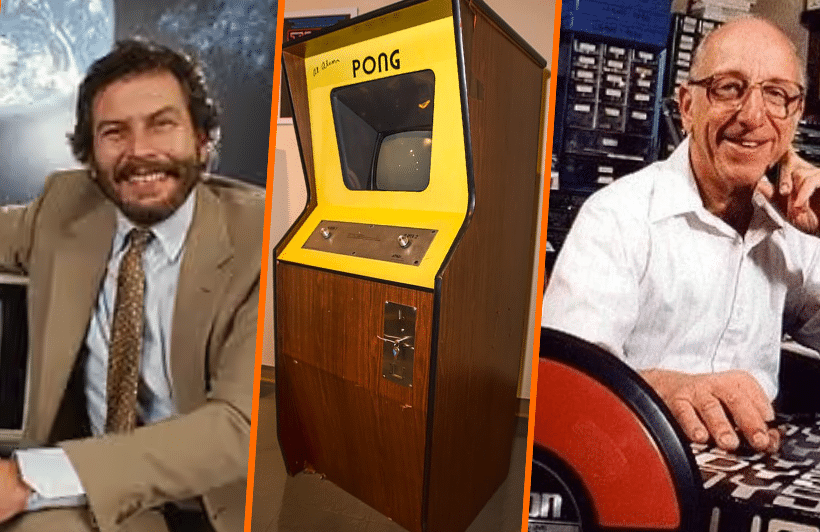
Ralph H. Baer was a German-American game developer and engineer. Among his most important contributions to the industry he helped build was the Magnavox Odyssey, the first commercial video game console.
Baer was born in 1922 in Pirmasens, Germany, a small town along the German-French border. In 1936, when Baer was just 14 years old, the Nazi party passed segregation laws that expelled Baer and all Jewish students from public schools. Facing increased prejudice in their homeland, Baer’s father saved what little he could while working in a shoe factory to relocate his family to New York. They left just two months before Kristallnacht (the Night of Broken Glass), when Hitler Youth and Nazi party members targeted Jewish businesses, homes, and places of worship for destruction.
While they were safe in New York, the immigrants escaping prosecution found few opportunities. Baer left school to work in a small factory to earn money for his family, self-educating with books borrowed from other displaced Jewish families. He took a particular interest in electronics, radio, and radar technology; after seeing an ad for the National Radio Institute at a bus stop, he began taking night classes in electrical engineering. Baer graduated as a Radio Service Technician, but the military drafted him quickly as America entered World War II.
Because of his advanced understanding of electronics, the military assigned Baer to military intelligence and deployed him to London to help reverse-engineer captured enemy weaponry. During his service, he collected nearly 18 tons of German military instruments and weapons, which he donated to several museums upon his return to the US in 1946. This kind act, combined with funds from the G.I. Bill, granted Baer entry into the prestigious American Television Institute of Technology in Chicago, where he graduated with a bachelor’s degree in television engineering.
In just six years after graduating, Baer developed hundreds of devices ranging from precise cutting systems to electric razors. He quickly gained a reputation among the engineering community for his ingenuity and technical prowess. He eventually settled at defense contractor Sanders and Associates in 1956, where he began developing one of his most famous creations.
An Electronic Game You Play on a Television
While at Sanders and Associates, Baer worked on improved forms of radar equipment. While tinkering with the oscilloscope display, he became fascinated by the ability to control items on the screen using attached hardware. Baer figured a simple ping-pong style game would be feasible on the machine. At the time, Baer was unaware of a similar 1958 game, “Tennis for Two,” which used similar hardware but was dismantled and never sold as a commercial product.
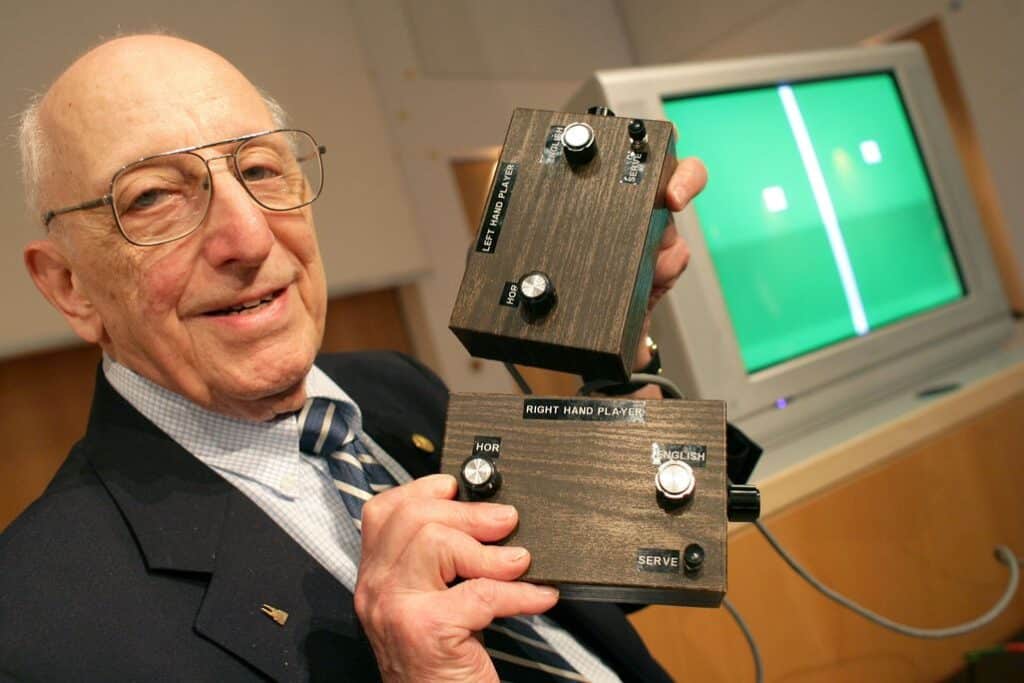
Baer received funding to build a small team and prototype the concept. The result was a simple “Brown Box” that attached to a standard television screen. The device rendered three movable square “dots” and one unmovable center line. This allowed for a simple game of Pong, though players had to keep score manually. The simple console lacked sound and ran on six AA batteries, though an optional AC adapter was available. Baer also designed a light gun that could be added to the machine.
By 1966, the console was ready for production. Since the concept of a “video game” did not exist yet, Baer simply called his creation a “Television Game.” Sanders and Associates, a company known for military hardware, never intended to sell the Brown Box directly. Instead, Baer sought to license the concept to another hardware manufacturer under a newly created division, Magnavox. Due to an economic downturn in the late 1960s, only RCA expressed interest, but they ultimately turned down the risky and costly project. RCA executive Bill Enders considered this a massive mistake, as he saw a huge emerging business in the simple game box. He left RCA to join Magnavox, where he worked with Baer to alleviate the production concerns RCA had held. By 1971, Enders convinced Magnavox to produce the “Magnavox Odyssey.”
The First Home Console
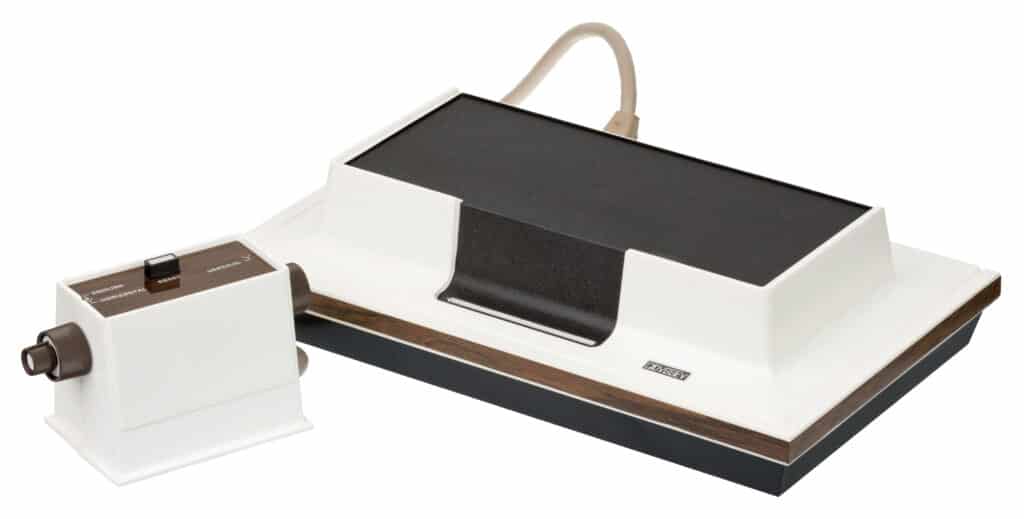
The Magnavox Odyssey was intended to retail for roughly $25 and contained several games, mostly variations of tennis or simple button-mashing games. During production, the team deemed a separate rifle accessory and game too expensive to ship. Instead, they spun it off into an “amusement game” called Shooting Gallery and sold it to carnivals and family centers. The system also included dice, playing cards, and overlays that stuck to the TV to enhance the simple graphics.
These additions and licensing fees raised the cost to around $99 (approximately $750 today). Marketing struggled to communicate what the expensive system actually did, with limited ads calling it “a brand-new electronic game from the future.” Additionally, as Magnavox grew, they sold the Odyssey only at authorized Magnavox stores. They believed the device was too expensive and confusing for average consumers, but hoped curiosity about the games would drive foot traffic into stores.
Of the 140,000 units produced, the Magnavox Odyssey sold only 69,000. Despite poor commercial performance, Baer remained convinced that the problem lay in the high price and lack of advertising—factors future versions could rectify.
Everyone Already Had the Idea for Pong in Their Heads
Baer and the Odyssey soon faced a new problem. In 1972, Atari released its arcade title Pong, now widely considered the first commercially successful arcade game. Prior to Pong, Atari co-founder Nolan Bushnell had created Computer Space, a standalone arcade game based on Spacewar!, a game he had seen on academic computers in the 1960s. Computer Space was a commercial failure, but Bushnell still believed in the market for electronic entertainment. He ordered a new hire, Allan Alcorn, to prototype a simple game using the same hardware.
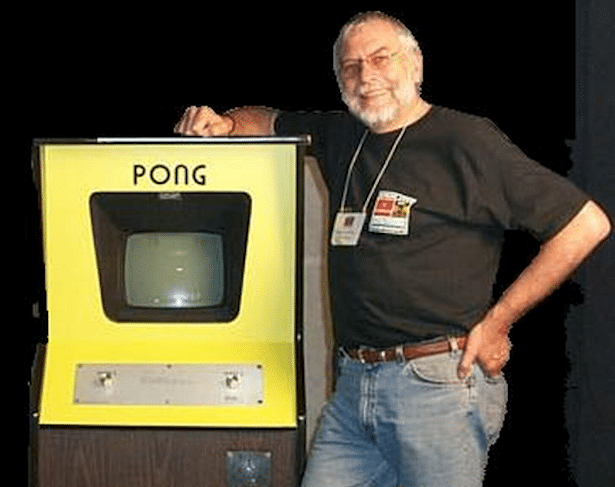
The two men offer competing arguments on how Pong was created. Bushnell claims the idea came from a game he saw when he was younger—likely Tennis for Two or a variant developed by amateur coders. However, Alcorn claims that Bushnell saw a demonstration of the Magnavox Odyssey the year before and ordered him to create a copycat that could keep score electronically.
Alcorn found the base game boring and sought ways to make the gameplay more interesting. He divided the paddle into segments that added spin to the ball, making the trajectory harder to anticipate. Bushnell also demanded that the game feature audio, which Alcorn accommodated after attaching the hardware to a Hitachi black-and-white television. The device was ready for market, but it bore a striking resemblance to the tennis game featured on the Magnavox Odyssey.
It’s Lawsuit Time
Pong was a massive commercial success that arguably started the modern video game industry. In 1974, Baer and Magnavox took Atari to court. Magnavox argued that Atari had infringed on Sanders and Associates’ patents regarding the concept of TV games and the interaction of player-controlled objects on a screen. They presented detailed records Baer had kept of the Odyssey’s design process since 1966. Other evidence included a signed guest book proving Bushnell had played the Odyssey’s table tennis game before releasing Pong.
This evidence forced Bushnell to admit he had played and been impressed by the tennis game years prior. Atari settled out of court in June 1976, agreeing to license the game from Magnavox for $1.8 million paid in eight installments. Furthermore, the agreement granted Magnavox full visibility into Atari’s products for one year to ensure no further ideas were stolen. This delayed the release of the Atari 2600, as Bushnell did not want to tip off his only actual competitor. Magnavox largely left Atari alone after the settlement, as they were busy pursuing dozens of other competitors who had created tennis games following Pong’s success.
A Complicated Rivalry Led to Mutual Respect
As the video game business exploded during the 1970s, many looked to Baer and Bushnell as the industry’s founding fathers. While Baer was relatively indifferent toward the title, he viewed Bushnell as someone with no actual ideas who had been “telling the same nonsensical stories for over 40 years.” Baer continued creating electronic games, including the wildly popular Simon, until his retirement in 1987. He spent his remaining years in a leadership role with the IEEE, defining electrical standards for consumer devices. In 2006, President George W. Bush awarded Baer the National Medal of Technology and Innovation.
In his final years, Baer enjoyed tinkering with electronics at his home in Manchester, New Hampshire. He eventually conceded that Bushnell had done more for the industry in the years following their disputes. Nonetheless, he graciously accepted the title “Father of the Video Game Industry” while sharing the honor with Bushnell, who is known as the “Father of the Arcade Game.” One of Baer’s last projects was recreating the original Magnavox Odyssey at home using parts from local electronics shops.
Baer passed away peacefully in 2014. Upon hearing the news, Bushnell reportedly teared up and released a statement saying, “Baer’s contributions to video games should never be forgotten.”
