
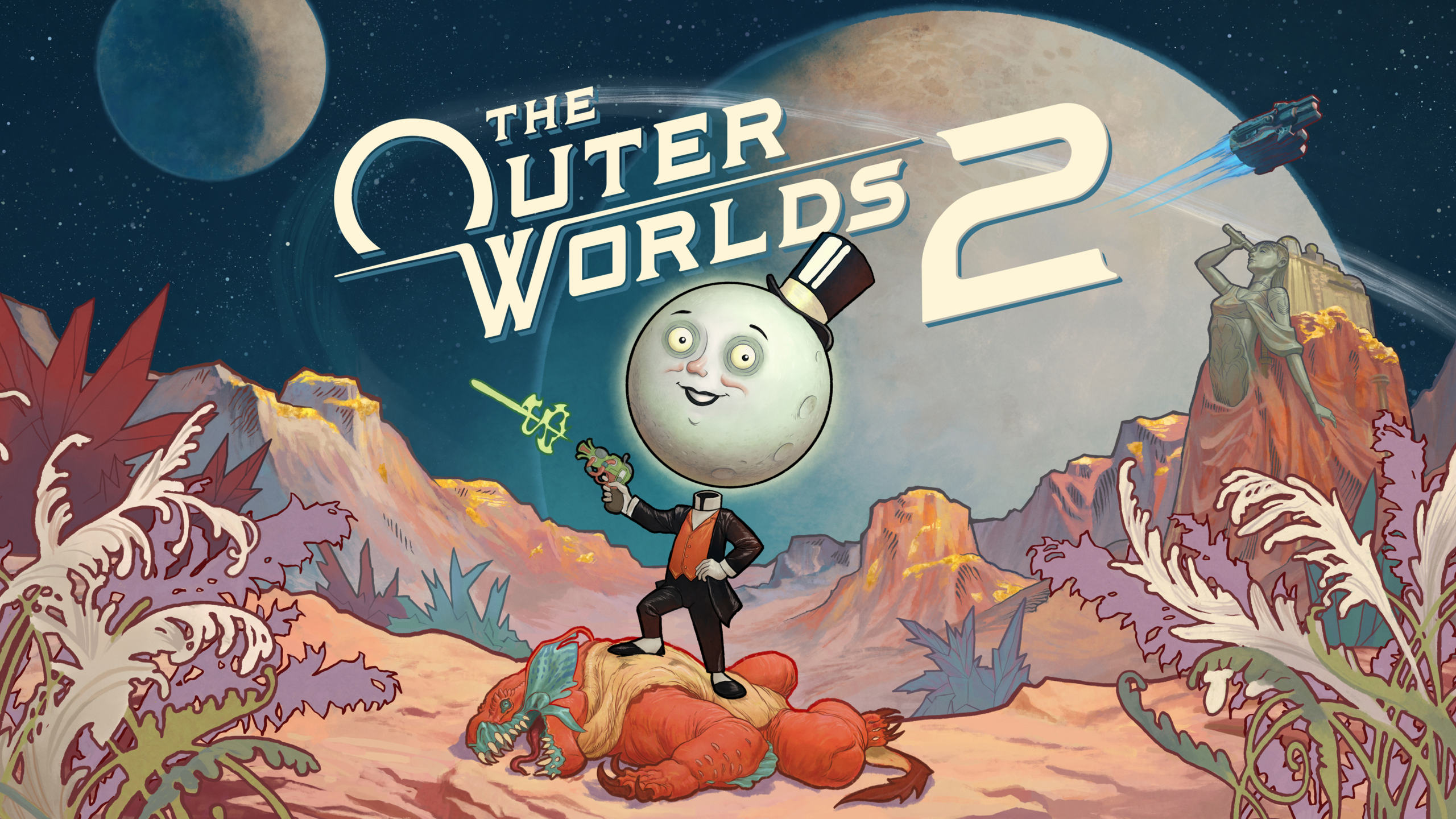
“A sequel that’s bigger and better in almost every way. Except the most important ones.”
The original The Outer Worlds was a pleasant surprise when it launched in 2019. Developed by the famed RPG studio Obsidian, it combined elements of the developer’s original work—mainly the beloved Fallout: New Vegas—with a brand-new story centered on a hyper-capitalistic society among the stars. The game was also very, very silly, employing the same cynical, absurdist humor that the Fallout franchise is known for. Similarities aside, the game was a solid first attempt at an entirely new sci-fi RPG series, and I looked forward to the studio’s sophomore effort with their new IP.
The nihilistic world-building hits a bit harder in 2025
Players take on the role of a Commander of the Earth Directorate, a group of space ne’er-do-wells tasked with rooting out corruption and lawlessness among the factions competing for resources in Arcadia, a dystopian system far across the stars. Three groups vie for power: the hyper-capitalistic Auntie’s Choice mega-corporation, the math-obsessed Order of the Ascendant, and The Protectorate, a militaristic society that prohibits independent thinking. Each of these factions is as exaggerated and evil as they come; even the seemingly good-aligned Order has more than a few (literal) skeletons in its closet.
Amid this societal struggle, an emerging danger presents itself in the form of “rifts”—tears in the fabric of reality with cataclysmic implications. On a routine mission to investigate these rifts, the Commander and their team are betrayed from within, setting them off on a mission of revenge with society-wide consequences.
Like the first game, The Outer Worlds 2 is almost a comedy, which is a refreshing change of pace for RPGs. This time around, however, the writers have committed more to the world and its characters, playing things seriously when the need arises. While not exactly Shakespeare, the overall plot is serviceable, if predictable. The quality of the character writing and jokes is definitely a notch above the norm, with the hilariously bottom-line-obsessed affiliates of Auntie’s Choice standing out as a corporate entity more than happy to engage in “hostile” acquisitions.
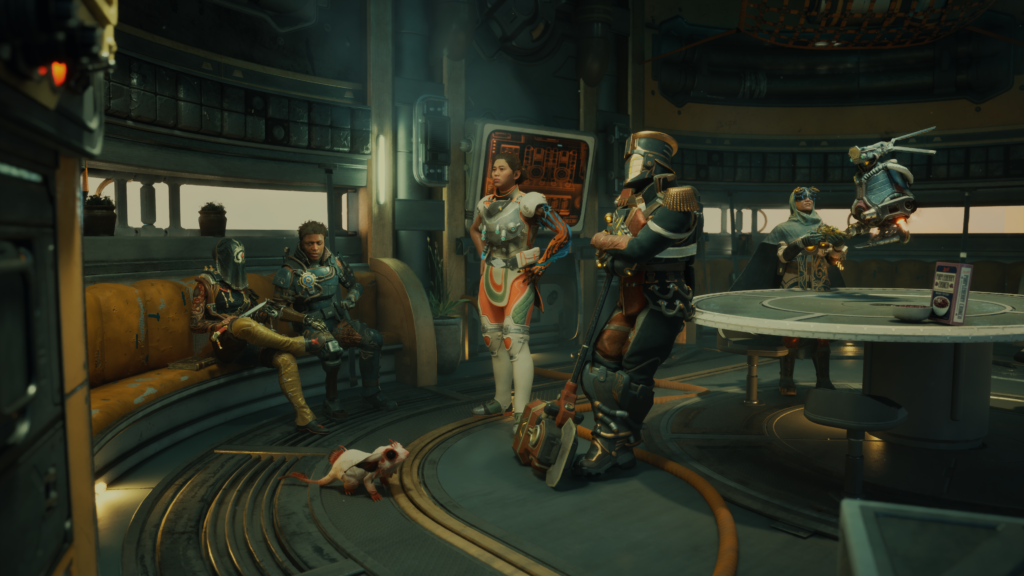
The Commander is joined by half a dozen companions who range from a forgettable robot—whose personality I’ve seen in enough games that I’ve taken to calling it “Walmart-brand HK-47″—to a blissfully deranged psychopath who adoringly never rises above her own bloodlust. None of the companions are quite as memorable as the beloved Parvati from the first game, but as a whole, the crew feels like a deranged family of outsiders—exactly the Firefly-inspired ensemble these games strive for.
An RPG system with plenty of “Flaws”
Gunplay has definitely been updated and feels as solid as any modern FPS title. Very little of the combat relies on the RPG systems powering things behind the scenes; if you’re the type who wants to play without diving into advanced builds or theory crafting, you are absolutely invited to jump right in. Movement feels great, amplified by a very fun double-jump, though don’t expect any gravity-based physics—a fun, if underused, mechanic in Bethesda’s Starfield that seems like an obvious way to introduce variety here.
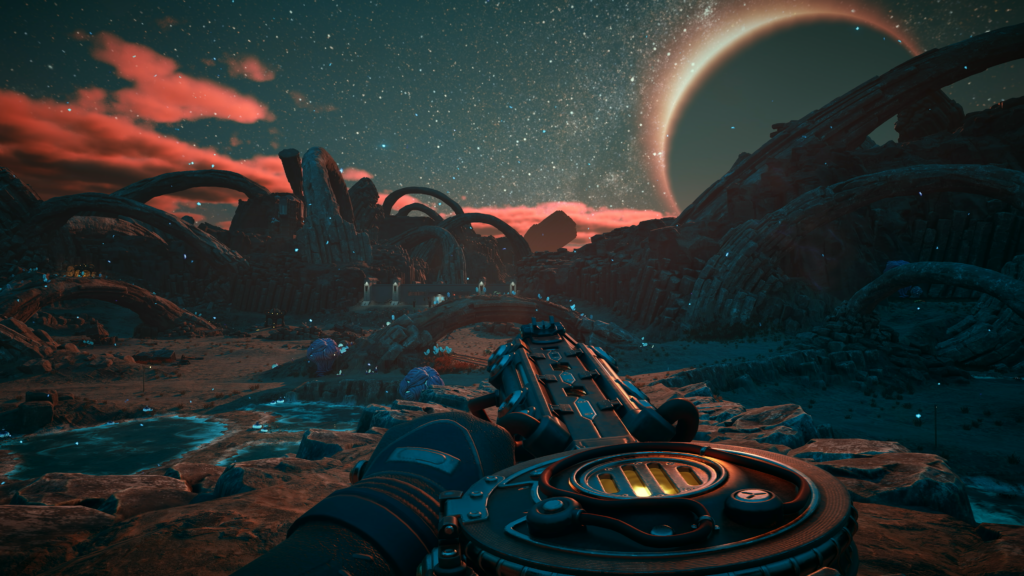
Speaking of variety, The Outer Worlds 2 falls flat in its enemy design. You’ll need to get used to seeing the same five or six enemy types repeated almost infinitely across the entire playthrough. Boss battles are similarly underwhelming; while they may seem to have interesting mechanics, most are over in a hail of bullets so fast that the player rarely has a sense of what is actually happening in the fight.
Of course, the meat of any RPG is character building, and this is unfortunately where the game comes short. Players are given two skill points per level to allocate to a myriad of skills ranging from guns and speechcraft to lockpicking. Every other level also awards a perk point for bigger boosts, usually in the form of passive combat buffs.
For my playthrough, I specialized in speechcraft, leadership, and guns, taking all three to their maximum value across the game’s paltry 30 levels. If you do every side quest, you will unfortunately hit the level cap a solid 10 to 15 hours before the end of the game. Skills are well-applied throughout the world, with an equal amount of problem-solving and speech challenges, but there was a distinct feeling of needing to specialize in just a few skills rather than spreading the meager points out.
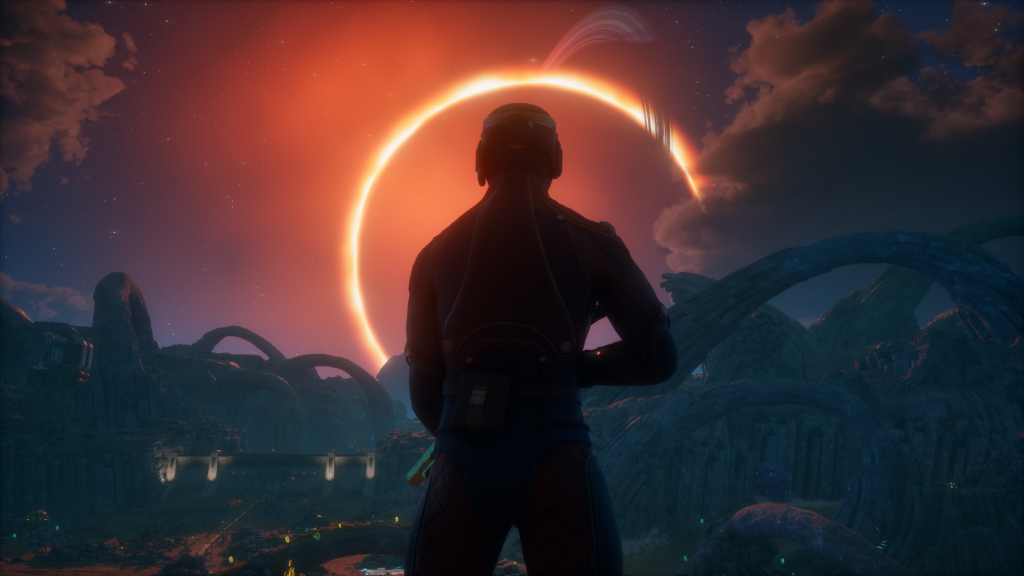
Perks were ultimately disappointing, typically granting statistical bonuses rather than anything game-changing. A much more interesting system is the returning “Flaws,” in which a character is offered a bonus in exchange for a downside. These occur when the player exhibits certain behaviors, such as the “Bad Knees” flaw: players who frequently crouch and uncrouch may gain a bonus to stealth, but in exchange, the character groans loudly in pain every time they take a knee, giving away their position. Flaws can be transformative, such as the “Kleptomaniac” flaw which causes your character to steal items automatically, making it impossible to spend time among civilized people. I found the flaw system to be the only RPG mechanic that had a noticeable impact on how I played.
As a final note on balance: I played on the default difficulty, which was almost obnoxiously hard at the beginning but left me feeling unstoppable after about five levels. In fact, I never swapped out the armor or weapons I found within the first ten hours. It was extremely disappointing to find tons of new equipment only to realize it simply wasn’t as effective as my starting gear. I’m not sure if this was a byproduct of me accidentally making “perfect” build choices, but I never felt the need to change equipment; when I did, enemies actually died slower. Conversely, in some fights, I would take an almost lethal amount of damage instantly without understanding why. For a game like this, it is vital that a player understands how their choices impact combat, and sadly, The Outer Worlds 2 is among the worst-balanced open-world RPGs I’ve ever played.
But it’s very pretty
Graphics-wise, the game makes great use of current-gen hardware, offering both Performance and Quality options. I played most of the title in Performance mode and rarely noticed any drops below 60fps, even in action-heavy fights. The artists made the most of the “blank canvas” of alien worlds; every planet felt unique and dangerous, with the Auntie’s Choice space station, Undisputed Claim, being my personal favorite visual feast.
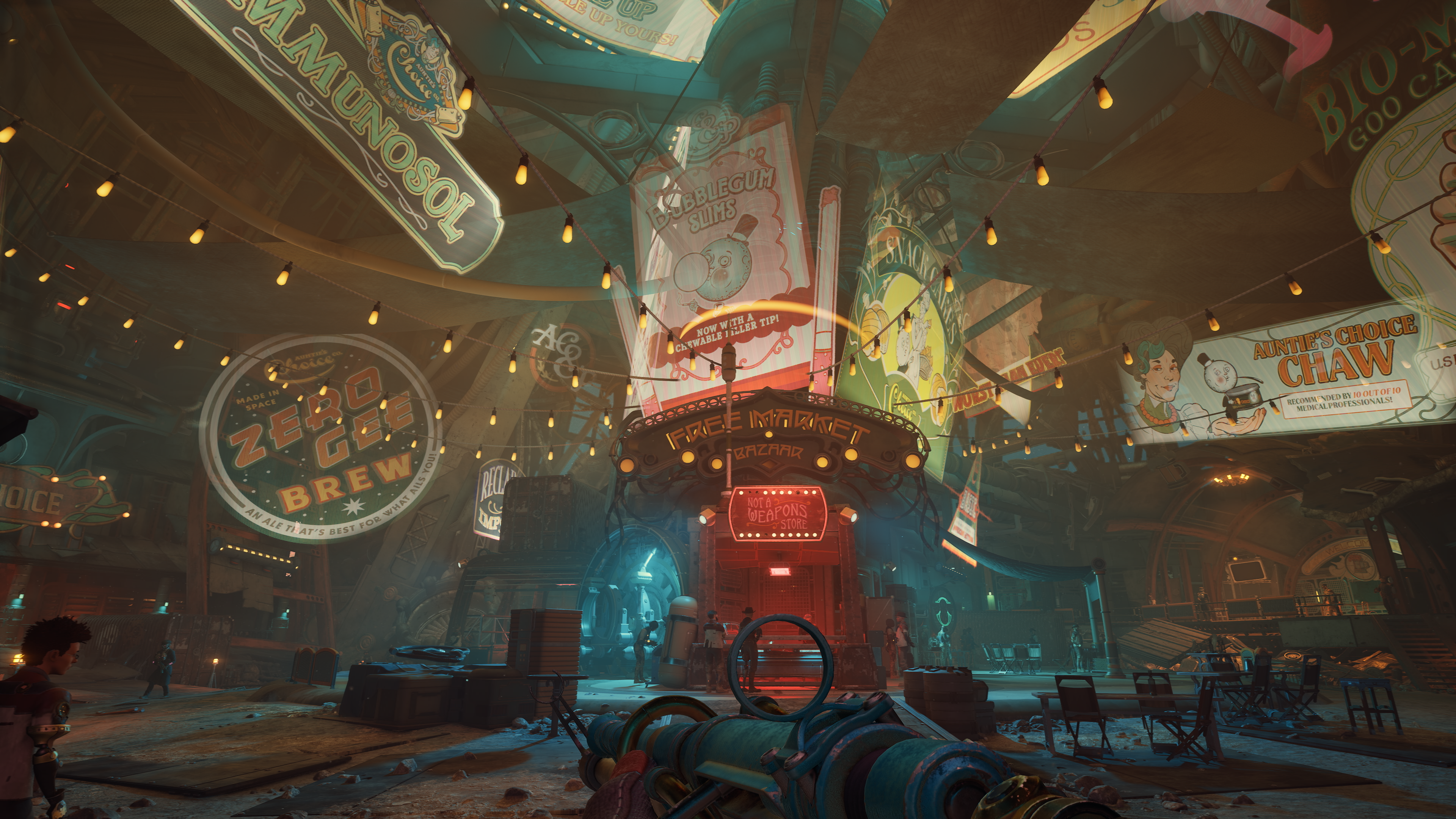
Audibly, the game is serviceable. The original standout theme is as memorable as ever, and the game features Fallout-style radio stations; Auntie’s Choice’s hilariously dark commercial jingles inadvertently became my favorite music moments of the year. The ambient music and sound effects are mostly fine, but the voice acting is stellar across the board. Sunil Malhotra’s stoic Tristan is an absolute standout. Even minor NPCs are voiced with aplomb, and credit must be given to the cast for landing dry humor—a difficult feat in this medium. Overall, it made me wish more big-budget titles attempted humor.
I’m a little less excited for a third game
Like the first game, I found myself supremely bored by the last third of the experience, rushing to the conclusion instead of enjoying the writing. While the narrative, characters, and graphics have all surpassed the original, the poor balance and lack of interesting RPG choices are disappointing. Compounding that, the decision to limit the character level to 30 meant that for a third of my playthrough, I wasn’t gaining experience. This led me to skip combat entirely, simply jumping and running through fights to reach the end.
This lack of progression, combined with the lack of gear variety, meant the last ten hours felt like a decent FPS devoid of the RPG character building that should have defined it. The one caveat is that the final “boss battle” for a high-speechcraft character was one of the best ways I’ve seen that handled.
Overall, I loved the world, the characters, and the humor. The core combat mechanics are flying high—it feels like the jump from Fallout 3 to Fallout 4 in terms of gunplay. But besides the delightful Flaws system, the RPG mechanics simply don’t support the gameplay enough to stay interesting. The absolute killing blow was an artificial level cap that disincentivized exploration and side-questing in the final hours.
Obsidian is an interesting studio, having cranked out no less than three massive open-world RPGs this year. I expect The Outer Worlds, which has already garnered multiple RPG of the Year awards, will get a third entry at some point. I’m excited to see where they take it, but I hope they look deeper into their New Vegas past to better integrate the RPG systems. As of now, The Outer Worlds 2 remains a fun, but ultimately forgettable, experience.
